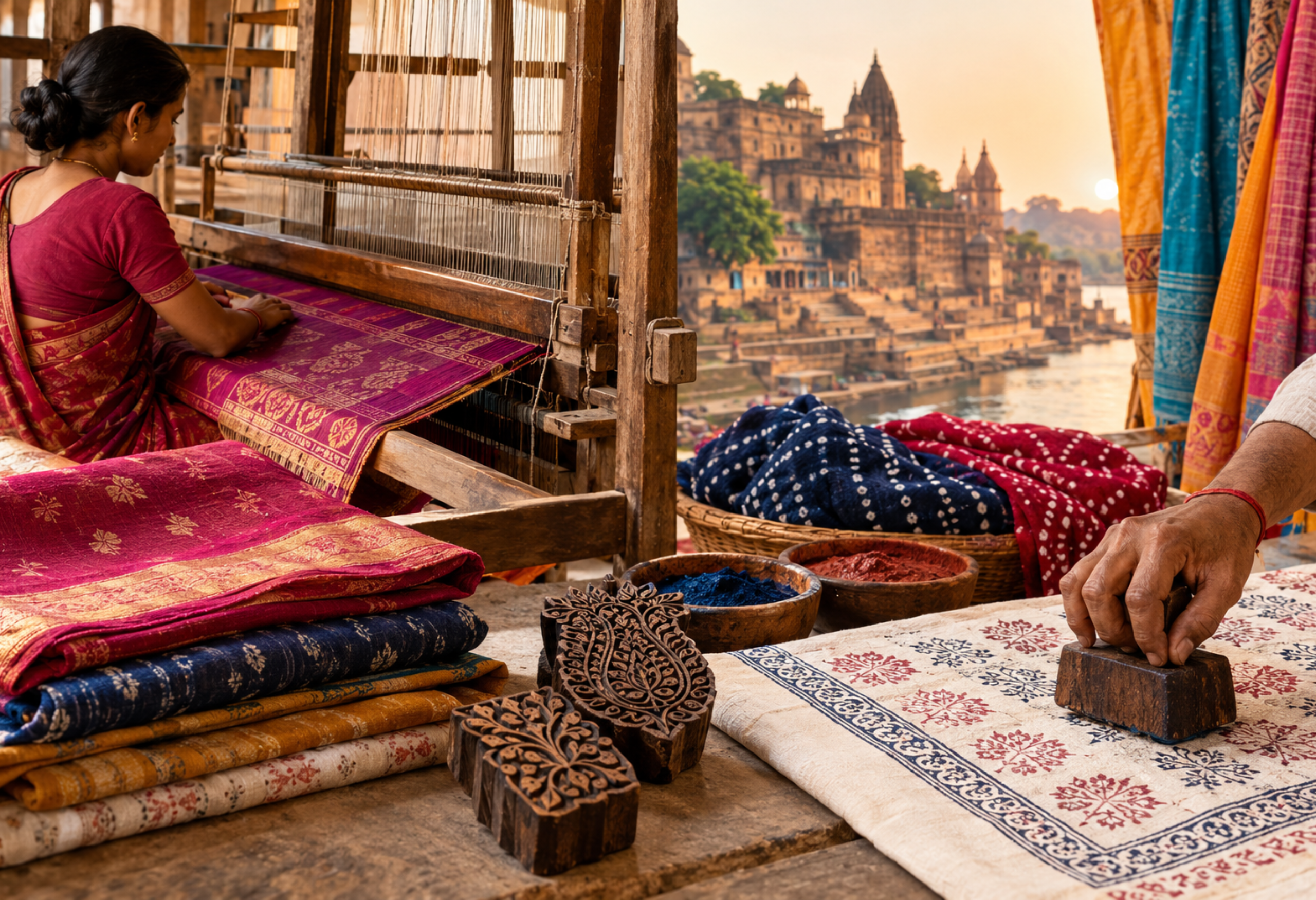
The best places to experience authentic traditional Indian handloom and textile crafts are in regional hubs specializing in age-old techniques: Maheshwar and Chanderi for silk weaving, Jaipur and Bagru for intricate block printing, Varanasi for opulent Benarasi brocades, and Kanchipuram for richly patterned silk sarees. Visiting these locations offers a unique opportunity to see skilled artisans at work, engage with their processes, and support their livelihoods. For tailored journeys that immerse you in these rich traditions, explore the Les Clés de l’Inde Arts, Crafts & Textiles Experiences.
Discover the Soul of India Through Its Exquisite Textiles
Indian handlooms and textile crafts are not only fabrics, but also stories that are part of the country’s tapestry. Many intricate arts are transmitted from generation to generation and are representative of local and regional culture and unmatched in skill. There’s so much more to these traditions than shopping in the markets, it’s a way to connect with Indian traditions.
In this guide, you will discover the main areas in India where certain textile crafts are prominent. We will take you on a journey from Madhya Pradesh to the printing blocks of Rajasthan, and to the sacred weaves of Varanasi. You’ll learn practical approaches to experiencing these crafts, and get some tips and tools to build your own immersive textile adventure.
Maheshwari and Chanderi: Weaving Legacies in Madhya Pradesh
Nestled on the banks of the Narmada River and amidst historical landscapes, Maheshwar and Chanderi are two crucial centers for fine handloom weaving in central India. Both yield fabric that is in great demand for its construction and design.
महेश्वर (Maheshwar): Where Royalty Inspires Art
It is Maheshwar which has been a weaver centre for more than 250 years, primarily by the patronage of Queen Ahilyabai Holkar. On a visit there you will be able to witness the colorful Maheshwari sarees in the making which are known for their:
- Special geometry patterns based on the carvings of the Maheshwar Fort.
- Comfortable and elegant rich silk and cotton fabrics.
- Unique and often removable edges (known as ‘palla’) to add a touch of versatile elegance.
To learn more about tailored cultural experiences across India, explore our Les Clés de l’Inde Tailor-made Journeys in India.
चंदेरी (Chanderi): Ethereal Sheerness and Opulence
The weaves of Chanderi are well known for their fantastic lightness, also known as “woven air. A great texture is created through a special fabric of which it is made from. Combination of good quality raw silk and mercerized cotton yarn. Important characteristics of Chanderi textiles are:
- The use of gold and silver ‘zari’ (brocade threads) adds a touch of shimmer.
- Traditional motifs and exquisite flowers are woven into sheer fabric, sometimes in traditional manner.
- These fabrics have a unique history, with the belief that they had only been worn by kings in India.
To understand more about the regional contexts of these crafts, browse through our Les Clés de l’Inde Regional Journeys.
Rajasthan: The Epicenter of Vibrant Block Printing and Indigo Dyeing
Rajasthan’s dry landscapes are brought to life by the brilliant colors of its traditional textile crafts. From block printing to intricate tie-and-dye techniques, the state offers some of the most accessible and visually stunning textile experiences.
| Regional Hub | Textile Craft Specialization | Key Characteristics & Processes |
|---|---|---|
| जयपुर (Jaipur) |
सांगानेरी ब्लॉक प्रिंटिंग (Sanganeri Block Printing) |
Known for its delicate floral and vine motifs, often printed on fine cotton or silk in soft, subtle colors. It often uses natural dyes and intricate multiple-block layering. |
| बगरू (Bagru) |
बगरू और डाबू ब्लॉक प्रिंटिंग (Bagru and Dabu Printing) |
Bagru printing often features geometric and traditional motifs in bold, natural colors like red and black. Dabu is a distinctive mud-resist process that creates fascinating indigo patterns. |
| पिपर (Pipár) |
बांधनी और बंधेज (Bandhani and Bandhej) |
A complicated tie-and-dye technique that creates tiny, intricate dot patterns. This requires immense precision and is practiced widely by artisan communities. |
Discover More India Experiences: Regional and Thematic Journeys
The above mentioned locations are just a handful of the textile journey of India. If you’re looking to craft a journey that mixes various crafts and cultures, then you can delve into our wide range of experience options:
- For tailored India journeys that connect multiple textile centers and cultural experiences, see our Les Clés de l’Inde Journeys.
- For a deeper understanding of the special nature of North India’s traditions, consider our Les Clés de l’Inde North India Regional Journeys.
- If you want to have fun and learn about crafts and nature, consult our Les Clés de l’Inde Diverse Experiences.
Frequently Asked Questions
What is the difference between Maheshwari and Chanderi sarees?
While both are known for their blend of silk and cotton, Maheshwari sarees are typically recognized for their geometric motifs inspired by temple architecture and often feature reversible borders. Chanderi sarees are distinctive for their incredible sheerness and light weight, often adorned with traditional gold or silver zari work.
How can I participate in a block printing workshop in Jaipur?
There are numerous NGO and craftsmen associations in Jaipur and Sanganer which conduct hands on block printing workshops. Les Clés de l’Inde can help you arrange private visits, which will give you access to expert printers to learn the technique and design your own souvenir, block-printed.
What are some eco-friendly options in Indian handloom?
Traditional handloom crafts have inherently eco-friendly aspects, such as the use of natural dyes and renewable fibers like cotton and silk. To support sustainable practices, look for certifications like ‘Handloom Mark’ or focus on centers specializing in organic materials and ethical production.
Key Takeaways for Experiencing Traditional Indian Handloom and Textiles
The traditional Indian handloom and textile craft is truly enriching to experience the heart of Indian culture. Your visit to the weaving centers in Madhya Pradesh and Rajasthan, your participation in the soft block printing, Chanderi sheerness or Maheshwari geometric borders, is an active support to the livelihoods of the artisans and age-old skills. To explore India’s amazing textile heritage with its different textures, patterns and stories, plan your immersive tour with Les Clés de l’Inde.